
T’aqrachullo:
The newly revealed Inca citadel hidden above the Apurímac Canyon
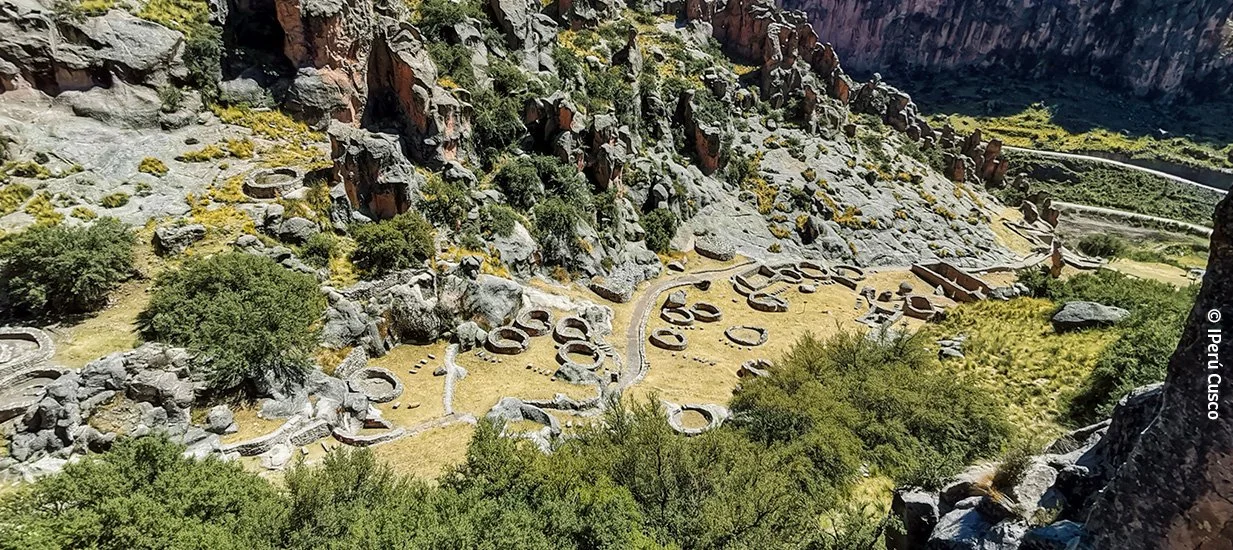
Peru’s archaeological map continues to expand with the recent recognition of T’aqrachullo, a remarkable pre-Hispanic complex located in Suyckutambo, in the province of Espinar, Cusco. Hidden for centuries at 4,038 meters above sea level, this impressive site is already being considered one of the most important archaeological discoveries in the Andes in recent decades.
Located about 225 kilometers northwest of Machu Picchu, T’aqrachullo occupies a strategic plateau overlooking the Apurímac canyon and covers more than 17 hectares. The site takes its name from two Quechua words — T’acra (mother rock) and Chullo (frozen water) — although during the colonial period it became known as “María Fortaleza” due to its imposing stone structures.
Since 2019, excavations led by Peru’s Ministry of Culture have documented nearly 600 archaeological structures across the complex. Visitors can now observe ancient dwellings, ceremonial spaces, water fountains, stairways, defensive walls, and chullpas, all surrounded by dramatic high-Andean landscapes.
The historical significance of T’aqrachullo increased further after researchers linked the site to Ancocagua, a legendary Inca ceremonial center described in colonial chronicles. International attention has also grown following a special feature published by National Geographic.
One of the most extraordinary discoveries came in 2022, when archaeologists uncovered a deposit containing nearly 3,000 gold, silver, and copper sequins wrapped in camelid leather. These delicate ornaments are believed to have belonged exclusively to the Inca elite and offer new insight into the ceremonial life of the empire during the 16th century.
As research continues, T’aqrachullo is emerging not only as a new archaeological destination in Cusco, but also as a place that may reshape our understanding of the final centuries of the Inca world.
For further information, you can read the full National Geographic investigation here.